You spent $60,000 on a trade show sponsorship. Your booth team had 200+ conversations over three days. Your VP of Sales left feeling good about it. You flew home, unpacked, got through the Monday meeting — and then someone emailed a CSV file. Leads. Finally.
Except it's Wednesday. Five days after the show closed.
By now, few of those people have already extended their conversation with your competitor. Some have moved on entirely. A few are still vaguely interested, but they don't remember the specifics of what you said at the booth, and your follow-up email — generic, untailored, referencing nothing real — isn't going to jog their memory in a good way.
This is not a rare scenario. This is the default for most B2B sponsors in 2026.
The Problem Nobody Wants to Own
Here's the uncomfortable reality that most post-event retrospectives skip over: the biggest threat to your trade show ROI is not your booth design, your messaging, or even your lead count. It's the 72 to 120 hours between the last handshake on the show floor and the moment a sales rep actually reaches out — and everything that gets mangled in between.
Moots' 2025 trade show data analysis puts it plainly: the optimal follow-up window is 24 to 48 hours after the event. Wait longer, and engagement rates drop dramatically. And yet, the same research finds that 80% of trade show leads are never followed up on at all.
Not poorly followed up. Not followed up late. Never.
SurFox's breakdown of why trade show leads die adds a dollar figure to this: with the 80% follow-up failure rate applied across the U.S. B2B trade show sector, the annual waste climbs to an estimated $5.4 billion. Per year. Just from leads that got captured and abandoned.
And the gap between the top and the bottom is not about effort. It's about systems — specifically, what happens between a badge scan on the show floor and a record appearing in Salesforce or HubSpot, ready for someone to act on.
What's Actually Breaking Down
Most sponsors assume their lead problem is a sales follow-up problem. It's usually not. By the time the rep gets the lead, three separate failure modes have already stacked on top of each other.
1. Context dies at the point of capture
Your booth rep scans a badge. They get a name, a title, a company, and an email address. What they don't get — and what doesn't get captured anywhere — is the 8-minute conversation that just happened. The pain the prospect mentioned. The competitor they're currently using. The fact that they have a decision to make before Q3. The part where the rep said "I'll send you the case study we did for a similar company."
Leadbeam's event lead generation guide calls this the context collapse problem: a badge scan tells you who a person is but not why you should care. That missing context is precisely what makes your follow-up feel cold — because it is cold.
2. Data lives in the wrong place — or nowhere at all
Badge scan exports go to one person's email. The handwritten notes from day two are in a jacket pocket. The business cards are in a Ziploc bag in someone's checked luggage. The lead retrieval app the event provided? It exports a CSV that doesn't map cleanly to your CRM's field structure and hardly has name, email and company name, basically registration details.
Limelight Platform's analysis of event lead management identifies this as the most common structural failure: scanning systems that don't sync with the company's CRM create a bottleneck that no amount of follow-up urgency can overcome.
3. The handoff between marketing and sales is broken by design
In approximately 42% of organizations, according to SurFox's post-event research, marketing assumes sales will handle follow-up while sales assumes marketing will nurture leads first. Nobody drops the ball intentionally. There's just no one holding it.
The result: leads sit in a CRM in an untouched import while both teams wait for the other to make the first move. Momencio's research describes this as the follow-up black hole — and it's endemic across B2B sales organizations.
What Sponsors Are Actually Saying
This isn't a problem that stays in retrospectives and survey data. It shows up in real conversations across communities where revenue leaders talk honestly about what's happening.
"We attended four enterprise tech shows last year. Our average time from event close to CRM import was 6 days. We tracked it because it felt wrong. It was worse than we thought. And that's not counting the time before a rep actually does anything with the record." — VP of Marketing at a series B SaaS company (Pavilion Slack)
A demand gen director at a cybersecurity firm posted in a RevOps LinkedIn group: "Our sales team genuinely doesn't trust event leads. When I dig into why, it's not that the leads are bad — it's that by the time they get them, there's no context, the data is incomplete, and they have no idea what was actually discussed."
"We spent $45k on a sponsorship at a major industry conference. The event's lead retrieval system gave us a CSV ten days after the show — with fields that didn't match our HubSpot setup. We spent two days cleaning it. By the time it was in the CRM and routed to the right reps, we were two weeks post-show. The reply rate was basically zero." — Field Marketing Manager (Reddit r/marketing)
And in a HubSpot community thread from mid-2025, a marketing ops manager put it more bluntly: "My team spends way too much time sorting and organizing leads after every event. Even after importing them into our CRM, our folks struggle with knowing which ones are actually worth prioritizing."
What It's Actually Costing You
Beyond the anecdote and the frustration, there's a measurable commercial impact to the data lag problem that most sponsors never calculate.
Moots' 2025 trade show data analysis show that 50% of trade show buyers choose the vendor that responds first with relevant information. Not the vendor with the best product. Not the most expensive booth. The one that responds first.
Responding first requires two things: knowing who to contact, and having the context to make the contact feel personal. Without fast CRM sync, you can't do either.
Research from revenue technology leaders found that responding quickly to a lead's inquiry boosts conversion rates exponentially. That benchmark is obviously set in a different context — inbound web leads — but the underlying principle maps directly to event follow-up: the faster you reach someone while the interaction is fresh, the more likely they are to engage. Every hour you wait, the probability of conversion drops.
Industry analysis quantifies the degradation: leads contacted quickly are significantly more likely to convert than those contacted after a week. And according to trade show research, a high percentage of attendees make a purchase decision within a few months of attending a show.
Add in the data from exhibition lead capture analysis, which shows that leads that never receive follow-up represent the single most prevalent cause of poor trade show ROI.
What Solving This Actually Looks Like
The solution to the data lag problem is not "be more disciplined." The failure isn't a willpower problem. It's a systems problem, and it requires a systems answer.
- At capture: The conversation context needs to be captured in the same moment as the contact details. Leadbeam’s trade show lead generation guide identifies this as non-negotiable.
- At sync: The data needs to be in your CRM before the show ends, not after. Limelight Platform’s analysis makes the point: seamless integration is key.
- At handoff: Leads need to hit the CRM already tiered and routed. Cvent’s 2026 guide to trade show lead collection describes Tier A leads in a queue before the show closes.
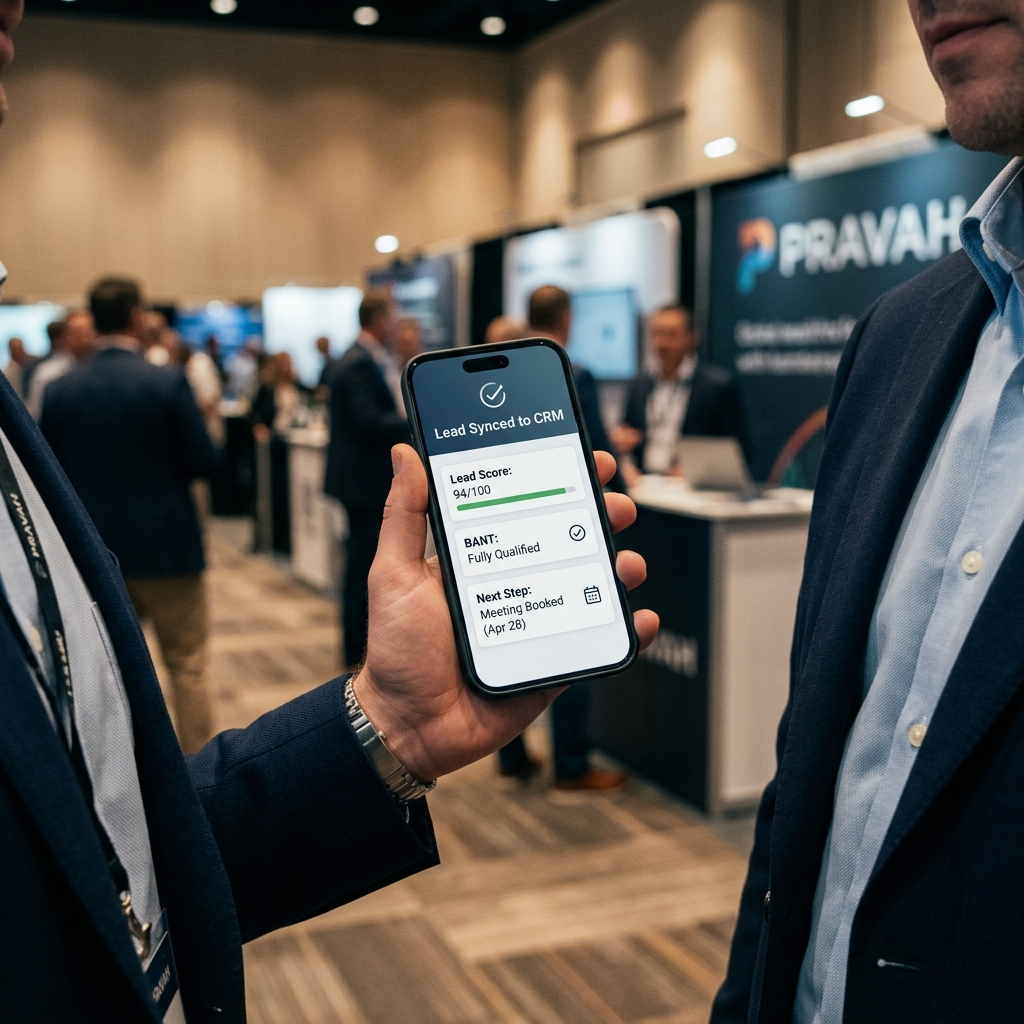
This is exactly what Pravah AI is built to close. Pravah captures full booth conversations — not just contact fields — and enriches each lead record with the intelligence that actually drives a relevant follow-up. The 3-day gap becomes a sub-hour gap.
What You Can Expect When This Is Fixed
Industry research shows that companies using lead capture technology report a significant increase in lead conversion rates. Recent ROI reports found that integrated teams had substantially higher close rates.
Beyond the numbers, you get cleaner attribution, faster sales cycles on event-sourced deals, and better event selection over time. Benchmarks show a strong ROI for teams that close the gap.
Frequently Asked Questions
Why does it take so long for event leads to reach the CRM?
Administrative friction. According to post-event research, the vast majority of lead response delays are caused by manual data enrichment and sorting exports.
How fast should I be following up with event leads?
Research shows that leads contacted quickly are many times more likely to convert. Tier A leads should receive outreach as soon as possible after the show closes.
Why does my sales team distrust event leads?
Context loss and latency. Cvent's trade show guide notes that without notes, sales can't distinguish between a prospect who had a qualifying talk and someone grabbing a bag.
Can Pravah AI fix the lead lag problem?
Yes. Pravah routes enriched, scored leads directly to your CRM in real time. book a demo with the Pravah team to see how the 3-day cleanup becomes a same-day handoff.
The next post in this series covers which events B2B SaaS sponsors should actually prioritize in 2026.