Every sales operations leader knows the post conference spreadsheet handoff.
Five days after hall close, field marketing sends a cleaned CSV file containing four hundred badge scans to sales operations. The operations analyst maps the headers, creates campaign member records, and runs the standard assignment rules in Salesforce. Within twenty minutes, the records distribute across thirty account executive queues.
On paper, marketing hit their service level target. Under commercial review, however, this handoff represents the exact moment event pipeline stalls.
In my fourteen years working commercial exhibition floors, watching enterprise revenue teams handle event routing, the CSV import is where trade show momentum evaporates.
When an account executive opens their queue on Monday morning, they see forty unannotated records. Each record displays a name, a job title, a corporate domain, and a lead source tagged with the event acronym. There are no notes explaining why the visitor stopped at the booth. There is no record of the specific technical capability they discussed, the current software vendor they mentioned, or the timeline they agreed to explore.
An enterprise rep carrying a million dollar quota cannot spend fifteen hours running cold outbound calls on unvetted names. The rep glances at the list, picks three recognizable Fortune 500 accounts, and leaves the remaining thirty seven leads sitting in queue status.
By the time sales development reps begin systematic outreach two weeks later, prospective buyers have returned to their normal operational fires. Over sixty percent of warm intent has evaporated.
Why do event leads stall inside Salesforce routing queues?
The core failure stems from treating in person event conversations like digital website form downloads.
When an enterprise buyer downloads a technical whitepaper online, their intent is passive. They expect an automated nurture sequence or a sales rep email within two business days. The buyer sits at their desk and can easily recall why they downloaded the document.
Trade shows operate on a completely different psychological wavelength. Attendees walk ten miles across concrete floors, absorb rapid pitches from two hundred competing vendors, and attend dozens of keynote presentations. Their cognitive capacity drops sharply by Thursday afternoon.
When a booth conversation ends without an agreed calendar hold, commercial context decays rapidly. According to the Salesforce State of Sales Field Benchmark Report, reaching an event prospect within 24 hours produces three times higher meeting conversion than reaching them on day five.
By day seven, the conversation is effectively forgotten. The attendee treats the follow up email as unsolicited cold outbound.
Relying on an after show CSV export guarantees this delay. Even the most efficient marketing operations teams require forty eight to seventy two hours to clean badge data, deduplicate against existing CRM records, and resolve conflicting territory ownership. That administrative buffer consumes the entire window of peak buyer recall.
As detailed in our guide on post event lead decay, post show lead lag is the single largest driver of unrecovered field spend.
What are the primary breakdown points in standard CRM lead routing?
Analyzing lead distribution breakdowns across enterprise sponsors reveals four repeatable operational bottlenecks.
1. Standard assignment rules erase booth rep ownership
When an account executive spends thirty minutes running a deep diagnostic conversation with an enterprise architect on the floor, they establish personal rapport. The rep understands the buyer timeline, political dynamics, and budget constraints.
Yet standard territory routing rules frequently assign that badge scan to a completely different rep who covers the geographic territory from an inside sales desk. The inside rep knows nothing about the floor conversation and sends a generic introductory template. The buyer feels disconnected and ignores the note.
2. Unannotated records force sales paralysis
When sales leaders enforce strict follow up quotas on unannotated leads, reps prioritize speed over personalization. They dump all forty contacts into an automated sales engagement cadence.
These generic sequences ask introductory qualification questions the buyer already answered standing on the booth carpet. The disconnect signals to the buyer that the vendor lacks internal coordination, undermining credibility.
3. Queue stagnation hides pipeline loss
When leads sit in shared holding queues or round robin pools without automated escalation triggers, accountability dissolves. Field marketing reports four hundred leads generated, while sales operations reports seventy percent of records untouched after fourteen business days.
Revenue leaders seeking to protect event ROI must eliminate batch CSV processing entirely and build direct commercial pipelines from the carpet into the CRM.
4. Attribution friction prevents budget defense
When lead handoffs drag across weeks, sales teams create new opportunities manually months later without attaching campaign history. Finance audits event spend, observes zero direct pipeline attribution, and cuts future booth space.
Our field marketing event attribution playbook outlines how revenue teams bridge this gap by enforcing structured milestone logging.
How do top performing sponsors eliminate the CSV handoff?
Top performing enterprise sponsors solve this friction by changing where qualification occurs. They qualify and route opportunities while the buyer is standing on the carpet, eliminating after show desk processing.
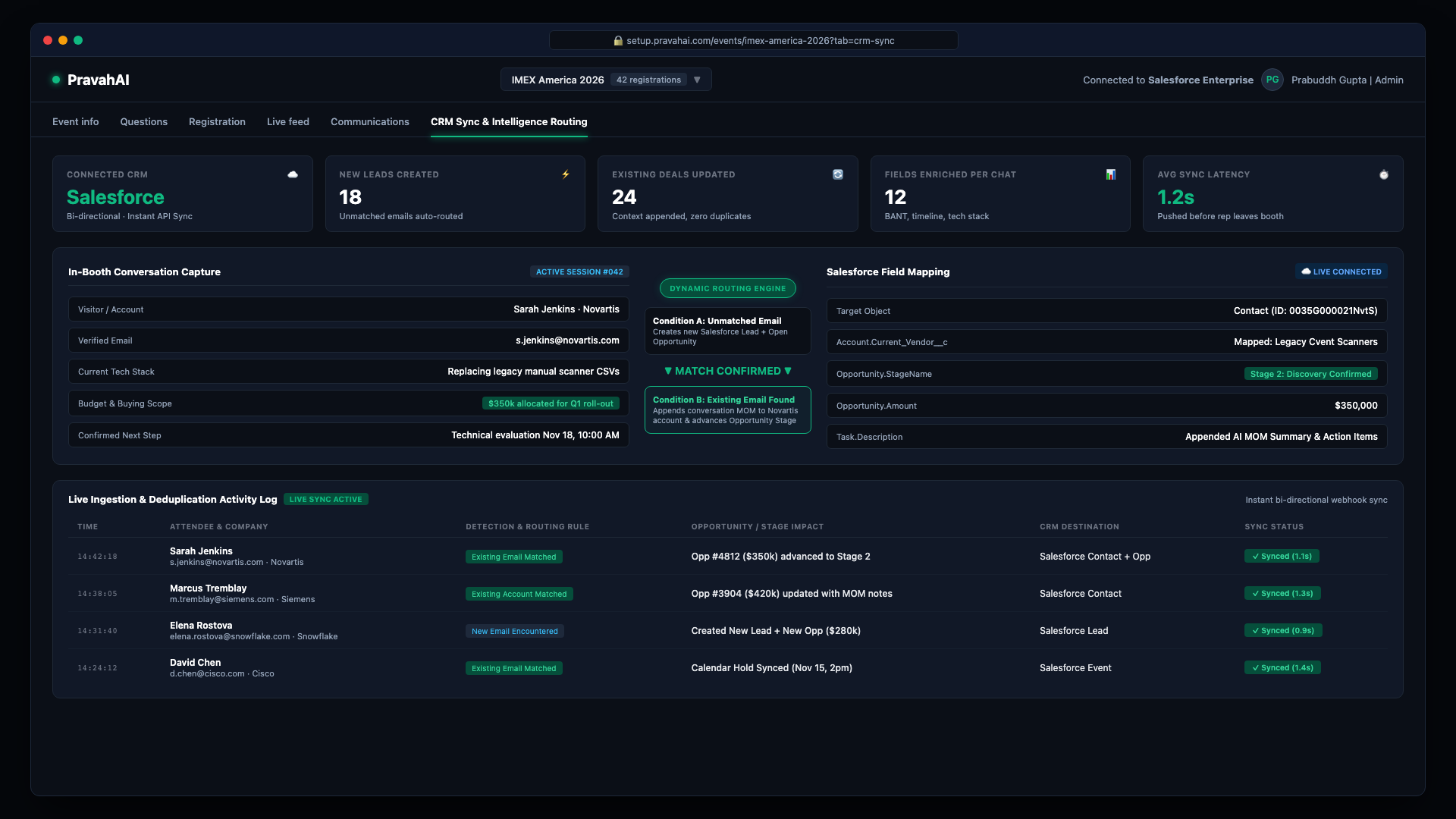
When a booth conversation reveals active technical requirements and purchasing authority, the rep captures key project drivers immediately. Commercial teams using PravahAI route structured qualification data directly into connected Salesforce stages before the attendee steps outside the convention center hall.
This immediate routing transforms post show execution across four operational areas.
First, verified conversation context attaches directly to the account record. The enterprise AE covering the account receives an alert containing the prospect timeline, existing contract renewal date, and specific technical gaps identified on the floor. Follow up communication references the exact discussion.
Second, calendar holds replace post show scheduling friction. Confirming a discovery milestone on the calendar while the buyer is engaged eliminates multi week email delays that kill event pipeline.
Third, sales operations gains live visibility into booth pipeline velocity. Revenue leaders track qualified pipeline creation during exhibition hours, ending reliance on delayed spreadsheet handoffs.
Fourth, lead assignment aligns to conversation ownership. If an enterprise AE conducts the discovery session on site, CRM records route directly to that rep, preserving commercial continuity.
How should RevOps configure Salesforce for real time event capture?
Configuring Salesforce for immediate event ingestion requires moving away from generic Web to Lead forms and legacy campaign batch uploads. Enterprise operations teams should implement four specific technical configurations prior to show opening.
First, establish dedicated custom fields on the Campaign Member and Opportunity objects for event specific qualification data. Essential fields include Verified Timeline, Existing Infrastructure, Primary Commercial Blocker, and Agreed Next Step Date. Populating these fields during the live conversation ensures that lead routing rules evaluate project urgency immediately.
Second, implement automated rep notification workflows triggered by event stage advancement. When a floor conversation qualifies an account as enterprise ready, an immediate Slack or CRM notification alerts the dedicated account team. The notification delivers the full conversation summary, allowing inside SDRs to coordinate executive collateral before the attendee returns to their hotel.
Third, build strict SLA tracking dashboards that monitor touch velocity by hours instead of days. If an enterprise lead generated on the booth floor does not receive personalized executive confirmation within twenty four hours, the record escalates to the regional sales director.
Fourth, implement bi directional CRM deduplication protocols. When an existing customer or active opportunity visits the booth, the system appends conversation insights directly to the open deal. This architecture avoids duplicate orphaned lead records and ensures account executives have complete visibility into executive touchpoints.
Fifth, establish clear stage progression criteria that distinguish warm marketing contacts from sales accepted pipeline. By gating opportunity creation behind verified budget milestones and calendar dates, revenue operations prevents reps from inflating early stage pipeline numbers with unqualified badge scans.
What commercial outcomes do teams achieve with immediate CRM routing?
Shifting from delayed CSV imports to real time CRM synchronization produces measurable operational improvements across enterprise revenue teams.
First, time to first touch drops from an industry average of nine business days to under four hours. Prospects receive tailored executive recaps while key discussion points remain fresh in memory.
Second, qualification conversion increases substantially. When follow up notes reference exact technical constraints voiced during the conversation, enterprise buyers engage at double the rate of generic event sequences.
Third, Cost Per Qualified Meeting (CPQM) declines because high value booth discussions convert into active pipeline milestones without expiring in unmonitored holding queues.
Fourth, executive revenue visibility becomes predictable. CFOs and revenue leaders audit initial sales qualified stage advancement during the event, providing verifiable data to justify six figure exhibition investments.
Fifth, sales rep morale improves noticeably. Instead of spending post conference weeks calling unverified dead ends, account executives spend their selling hours advancing qualified commercial discussions with engaged enterprise buyers.
Trade show sponsorships require significant capital commitments. Protecting that investment requires treating commercial booth conversations with operational discipline, replacing batch CSV imports with direct, real time CRM routing.
Revenue operations teams that master live qualification turn exhibition carpets into predictable growth engines. Eliminating batch latency protects commercial deal momentum and establishes clear executive accountability across marketing and sales leadership.