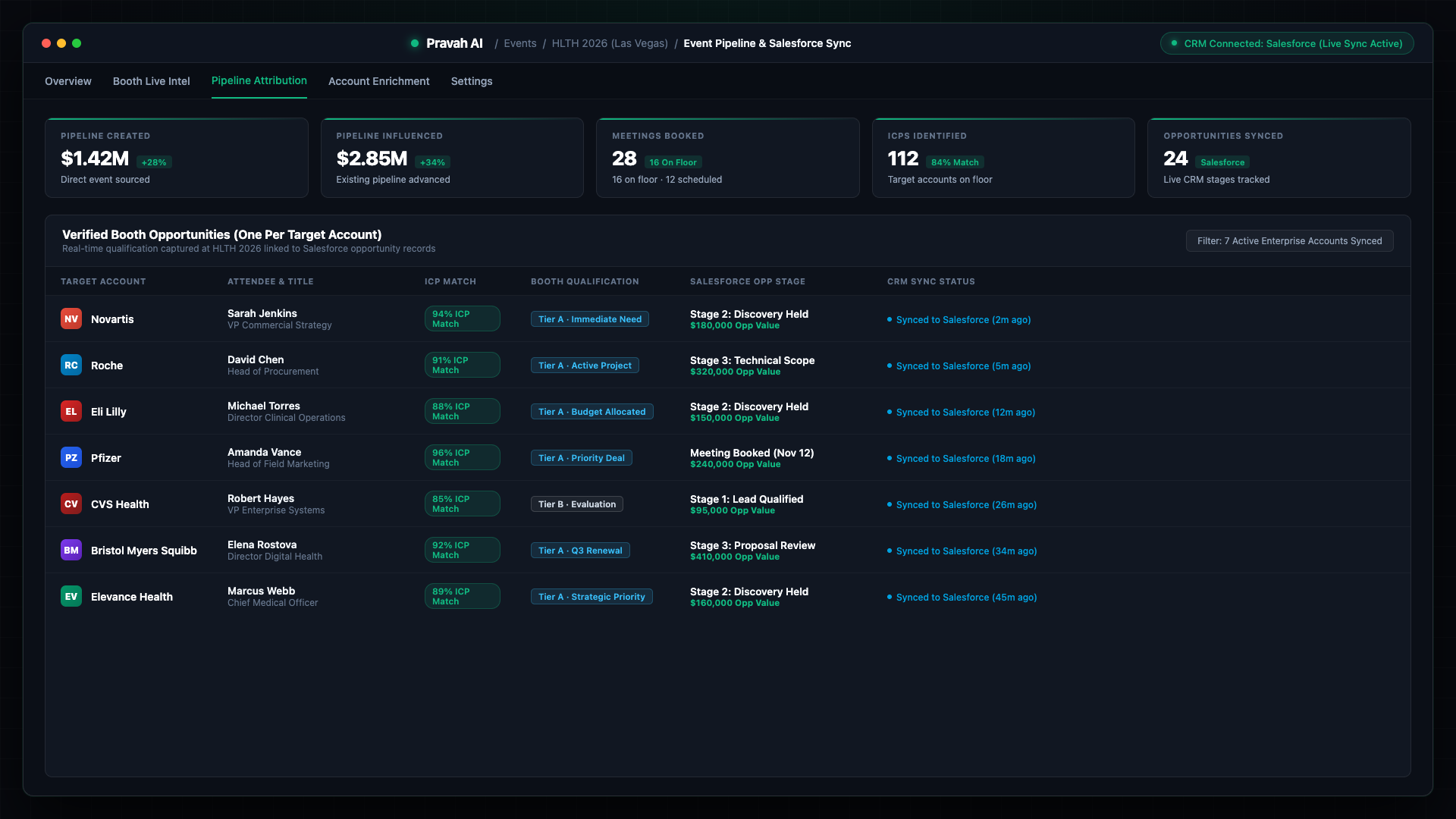
Field marketing leaders face a growing attribution squeeze. Industry benchmarks from Forrester research show that 73% of field marketers are measured directly on pipeline or revenue influenced by events, yet half see flat budgets and constant pushback from sales leadership over who owns the revenue.
When an enterprise deal closes six months after HLTH or Money20/20, sales leadership routinely logs the win as outbound prospecting or direct account executive effort. Field marketing points to a badge scan from the Las Vegas exhibition floor. Sales counters that the attendee only stopped by for branded merchandise, while the account executive ran discovery, built the business case, cleared security review, and handled the procurement cycle.
Finance discounts the marketing claim because neither department can produce a verified record of what happened during the booth interaction. Field leaders can review the five questions every CFO asks before signing off on event spend to establish attribution frameworks upfront. Without documented qualification notes, the event looks like an expensive brand exercise.
A study of 150 enterprise event leaders by Sparks event intelligence found that 29% view proving event return to executive leadership as their main professional anxiety. Another 21% cite cross departmental buy-in as their most frequent operational struggle. When leadership examines line item spending, events without defensible conversation data are the first items cut.
Why Raw Badge Scans Destroy Attribution Credibility
Most enterprise event teams still rely on badge scanners rented from event organizers. These scanners collect contact metadata: first name, last name, job title, email address, and company name.
They capture zero conversation context. They do not capture what software the attendee runs, whether their team has allocated budget for a replacement, which executive signs off on the purchase, or when their current contract expires.
The traditional hand off process creates immediate friction across revenue teams:
- Delayed CSV Exports: As documented in our guide on why event leads take 3+ days to reach the CRM, lead lists arrive from event organizers forty eight to seventy two hours after the exhibition hall closes. Marketing operations spends two days cleaning inconsistent fields and mapping incomplete job titles.
- Context Stripped Handoffs: Contacts are loaded into Salesforce or HubSpot as raw records with no notes. Sales development reps see generic job titles and no indication of what was discussed on site.
- Sales Rep Cherry Picking: Account executives scan the list for two or three Fortune 500 company names they recognize and leave the remaining records untouched in the queue.
- Broken Feedback Loops: Because reps lack conversation context, their outreach reads like cold generic spam. Reply rates plummet. Sales abandons the list, and marketing absorbs the blame for low lead quality.
Attribution collapses at the operational gap between the handshake on the exhibition floor and the record inside the CRM.
Four Standards for Defensible Event Attribution
Securing executive trust requires field marketing to replace passive badge scanning with structured conversation verification. Top enterprise teams enforce four operational standards across the event lifecycle:
1. Pre Event Account Mapping
Four weeks before the exhibition hall opens, marketing and sales operations review the confirmed attendee list. Accounts are segmented into two distinct groups: Tier A strategic enterprise targets with active pipeline or upcoming renewals, and Tier B accounts matching ideal customer criteria.
Account executives assign meeting commitments against specific target accounts. Reps enter the booth knowing exactly which accounts require executive engagement and which past client relationships need check ins.
2. Standardized In Booth Qualification Criteria
Booth staff must evaluate incoming visitors against four objective qualification questions within the first three minutes of discussion:
- What software platform does the prospect currently deploy for this workflow?
- What specific operational bottleneck prompted them to evaluate alternatives this quarter?
- What is the timeline for their current vendor agreement or renewal cycle?
- Who on their executive team owns sign off for this initiative?
If a visitor lacks purchasing authority or an active project, booth staff offer high level collateral and politely redirect their time toward qualified buyers. Teams executing this qualification standard in high-traffic halls can reference our MWC Barcelona exhibitor playbook to maintain rep stamina. Standardized questions prevent reps from spending forty minutes chatting with students or non buying visitors.
3. Immediate CRM Record Creation
Conversation details must enter the CRM while the conversation remains fresh. When reps wait until they return to their home office, critical technical nuances evaporate.
Enterprise revenue teams deploying Pravah AI cut Cost Per Qualified Meeting by 70% and secure auditable pipeline attribution directly on the show floor. Account teams return from multi-day exhibitions with confirmed sales pipeline rather than unvetted badge lists.
4. Formal Attribution Rules Agreed with Finance
Attribution rules must be documented in writing and approved by sales leadership and finance before the event sponsorship agreement is signed:
- Direct Event Sourced: First substantive conversation occurred at the booth with complete qualification criteria, converting to an open opportunity within a sixty day window.
- Event Accelerated: An existing open opportunity advanced to a later deal stage following a documented executive briefing at the booth, credited at an agreed thirty percent influence weighting.
- Account Re Engagement: A dormant or lost account re opened discovery following a documented floor session with the account owner.
- Disqualified Badge Scans: Unverified badge scans without conversation notes receive zero attribution credit.
Traditional Workflow vs Structured Pipeline Verification
| Dimension | Legacy Badge Scan Method | Structured Verification |
|---|---|---|
| Data Captured | Name, email, company from badge barcode | Current stack, renewal date, pain point, deal size |
| CRM Entry Latency | 3 to 6 days post event via CSV upload | Real time sync during or immediately after the chat |
| Sales Rep Adoption | Low. Reps distrust unverified contact dumps | High. Reps receive scored records with meeting notes |
| Attribution Defense | Vague. Finance questions marketing influence | Defensible. Documented timestamps and stage criteria |
| Primary Metric | Total raw badge scans collected | Cost Per Qualified Meeting (CPQM) and pipeline velocity |
The Four Milestone Revenue Audit Cadence
Proving attribution is an ongoing governance practice that extends across the sales cycle. Field marketing should establish four formal review milestones with sales leadership following each major conference:
Day 14: Initial Execution Audit
Verify that 100% of booth conversations received structured follow up. Review response rates across Tier A and Tier B accounts. Audit sales development rep activity to identify any accounts left uncontacted in the queue.
Day 30: Discovery Conversion Review
Measure the conversion rate from booth conversation to held discovery call. Calculate initial Cost Per Qualified Meeting (CPQM) by dividing total show expenditure by confirmed discovery sessions. Compare against historical benchmarks to evaluate event performance.
Day 60: Opportunity Progression Check
Examine opportunities that progressed into technical validation or proposal stages. Audit deal notes to verify whether event context influenced buyer momentum. Identify stalled accounts that require marketing re engagement campaigns.
Day 90: Closed Revenue and Attribution Sign Off
Reconcile event sourced and event influenced revenue with sales operations and finance. Finalize the Cost Per Sourced Opportunity (CPSO) scorecard. Present documented revenue outcomes to executive leadership to justify budget allocations for the subsequent fiscal year.
Operational Routing Protocols for the CRM
Once conversation records exist with verified qualification data, revenue operations must enforce automated routing rules:
- Tier A Strategic Accounts: Automatically assign to the named enterprise account executive with audio transcription snippets and agreed follow up timelines attached to the account record.
- Tier B In Profile Accounts: Route to specialized inbound sales development reps with pre drafted follow up templates tailored to the visitor's stated software stack.
- Partner or Channel Inquiries: Flag directly to business development teams with meeting notes forwarded to the regional partner director.
- Non Target Visitors: Tag as event footfall in marketing automation without cluttering primary sales queues or active pipeline dashboards.