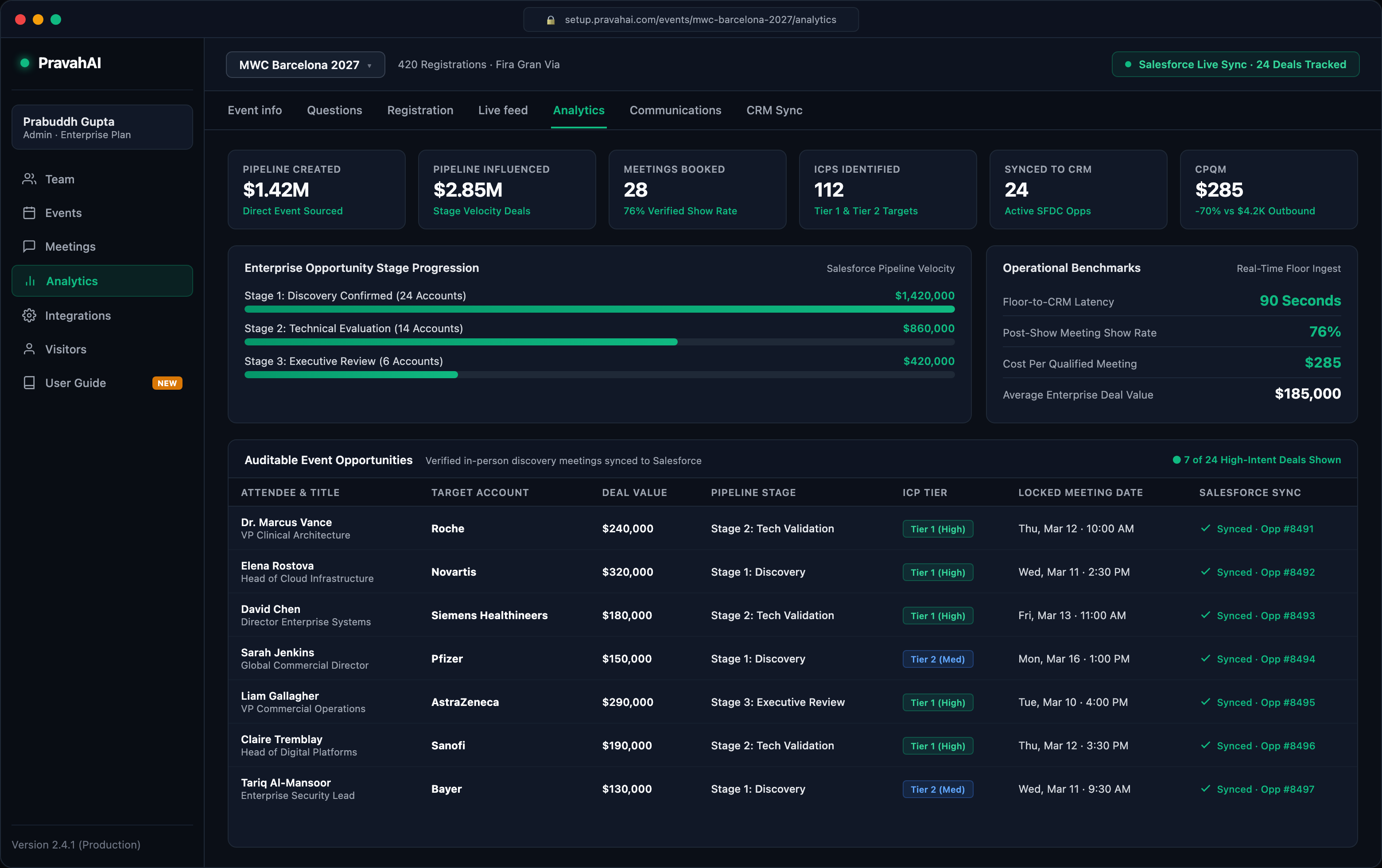
Every field marketing director knows the quiet dread of the fourth-quarter budget review.
The Chief Financial Officer opens a spreadsheet showing seven hundred and fifty thousand dollars in annual event spend. Across four major industry conferences, the company rented floor space, shipped custom tension fabric booths, and flew out twenty account executives.
The CFO looks across the conference table and asks a direct question: how much pipeline did those four exhibitions generate?
Marketing presents a multi-touch attribution report. The report attributes twelve million dollars in influenced revenue by weighting website visits, whitepaper downloads, and badge scans across a twelve-month sales cycle.
Finance rejects the slide deck immediately.
In the CFO's eyes, software algorithms that assign forty percent credit to an event because an enterprise buyer walked past a booth nine months before signing a contract aren't financial evidence. They look like self-serving marketing calculus.
When enterprise revenue teams navigate autumn budget reviews, this standoff plays out predictably. Finance threatens to cut booth footprint by half, marketing scrambles to defend brand visibility, and neither side agrees on how in-person commercial interactions convert into real enterprise value.
Resolving the standoff requires revenue leadership to abandon theoretical attribution models and build auditable milestone accounting.
The fundamental flaw in marketing influence models
The root cause of friction between marketing and finance isn't a lack of data. It is the type of data field teams present.
Most event attribution models rely on influence scoring. If a contact associated with an open sales opportunity attended a sponsored conference, the marketing automation platform tags the entire deal as event influenced.
Under corporate financial audit, this methodology collapses under three basic tests:
First, influence models ignore enterprise sales cycles. Enterprise software deals take between ninety and two hundred and forty days to reach closed-won status. Claiming that an executive signed a three-hundred-thousand-dollar contract because they picked up a branded notebook in March invites immediate skepticism from sales leaders and finance analysts.
Second, influence models fail to establish causation. Did the prospect evaluate your software because they met your technical team at the booth, or did they stop by the booth because an account executive had already spent six months running discovery calls? Unannotated badge scans cannot answer that question.
Third, influence models reward vanity volume over commercial qualification. A field team that collects six hundred low-intent badge scans appears more successful on an influence dashboard than a team that conducts thirty structured executive evaluations with confirmed calendar dates.
When finance audits trade show spend, they don't care about impressions, hall foot traffic, or fractional attribution percentages. They care about commercial momentum: did the event accelerate deal velocity, advance sales stages, or open verified pipeline that would not have existed otherwise?
As we outlined in our guide on the five questions every CFO asks before signing off on event spend, finance leaders evaluate sponsorships using capital allocation rigor, not brand goodwill.
The three milestone stages that survive financial audit
To defend event investments, revenue teams must replace disputed influence percentages with verifiable sales stage progression.
Auditable event accounting tracks three specific commercial milestones:
1. Sourced pipeline with verified evaluation criteria
Sourced event pipeline cannot be defined by raw badge scans or dropped business cards.
A record only qualifies as sourced event pipeline when an in-person conversation satisfies three explicit criteria before the attendee steps off the booth carpet:
- A documented technical or commercial pain point tied to an active corporate initiative.
- A verified current software vendor and replacement timeline.
- An agreed next meeting date locked directly on the calendar.
If an account executive cannot produce those three data points, the contact is a marketing lead, not commercial pipeline. Restricting pipeline definitions to verified criteria eliminates the bloated numbers that cause CFOs to discount field marketing reports.
2. Accelerated stage velocity on active enterprise deals
The highest commercial return on trade show investments often comes from advancing existing opportunities instead of cold prospecting.
Enterprise buyers rarely attend conferences to browse new software categories. They attend to validate architectural decisions, meet executive sponsors, and conduct face-to-face diligence on vendors they are already evaluating.
When an active prospect visits an exhibition booth, revenue teams should measure stage progression velocity:
- Did an Opportunity in Stage 1 discovery advance to Stage 2 technical evaluation within five days of the booth meeting?
- Did an enterprise security objection that had stalled negotiations for three weeks get resolved during an in-person session with a solutions architect?
- Did an executive buyer introduce their commercial decision-maker on the show floor, shortening the closing timeline by thirty days?
Tracking deal acceleration provides finance with concrete proof of commercial value without claiming unearned revenue credit.
3. Cost Per Qualified Meeting (CPQM) benchmarks
Finance leaders think in unit economics. They understand customer acquisition costs, customer lifetime value, and operating margins.
When marketing reports cost per badge scan, the metric carries zero financial meaning. Renting a five-hundred-dollar barcode scanner to collect five hundred names yields a one-dollar scan cost, but if none of those names convert into sales pipeline, the initial sixty-thousand-dollar sponsorship is complete waste.
Cost Per Qualified Meeting (CPQM) provides a clean financial metric that bridges the gap between field spend and commercial output.
To calculate true CPQM:
Take total event investment, including booth space, travel expenses, freight drayage, and staffing costs. Divide that total by the number of meetings conducted with verified enterprise decision-makers who hold active commercial timelines.
If an enterprise sponsor spends eighty thousand dollars exhibiting at an industry expo and secures twenty-eight verified executive discovery sessions, their CPQM is roughly two thousand eight hundred and fifty dollars.
When revenue leaders compare that figure against cold outbound acquisition costs, where securing a meeting with a Fortune 500 VP of Infrastructure often costs four thousand dollars in SDR salaries and software overhead, the business case for targeted trade show sponsorships becomes mathematically defensible.
Detailed operational frameworks for tracking these metrics are available in our field marketing event attribution playbook.
Why delayed CRM data entry breaks attribution accounting
The operational obstacle that prevents most enterprise teams from proving milestone attribution isn't software complexity. It is human latency.
Field teams stand on concrete floors for eight hours, absorb hundreds of commercial interactions, and return to their hotel rooms exhausted. Reps intend to log detailed discovery notes, but administrative data entry takes a back seat to customer dinners and evening Slack catch-ups.
When the show closes, marketing exports an unannotated spreadsheet from the contractor's retrieval portal. By the time operations uploads the records five days later, commercial context has evaporated. Reps cannot remember which director had an active budget, and the records sit unworked in generic queues.
When finance reviews the event three months later, the CRM shows sixty thousand dollars in marketing spend associated with forty uncontacted leads and zero logged opportunities. The budget gets slashed not because the event failed, but because the evidence was lost on the carpet.
Pravah AI helps close this gap by capturing each conversation on the show floor and agreeing next steps before visitors leave. Account executives confirm discovery milestones and agreed next steps before the prospect leaves the carpet, returning home with verified CRM opportunities that withstand executive audit.
Building the unified event revenue dashboard
Revenue teams that successfully protect field budgets establish four operational agreements between sales, marketing, and finance before signing sponsorship contracts:
- Agree on qualified meeting definitions upfront: Finance, sales leadership, and marketing must establish an ironclad definition of what constitutes a qualified booth meeting before the show opens.
- Mandate same-day CRM synchronization: Require structured qualification criteria to be logged within four hours of conversation completion, while commercial details remain fresh.
- Implement stage milestone tracking: Configure CRM dashboards to track how booth meetings influence opportunity stage progression over ninety-day post show evaluation windows.
- Conduct joint quarterly retrospectives: Review event performance using verified CPQM and milestone velocity instead of disputed influence models.
When field teams present auditable milestone data backed by verified buyer criteria, the annual CFO standoff disappears. Trade show sponsorships stop looking like expensive corporate vacations and take their rightful place as predictable, high-yield revenue engines.