Every autumn, enterprise marketing operations teams repeat an expensive ritual.
They hire consultants to build custom project boards. They configure complex dependency trees in Asana, build relational schemas in Airtable, and set up five separate SharePoint portals to manage floor logistics. They spend thirty-six months perfecting the machinery that gets forty sales reps to an expo hall on time.
Then the exhibition opens.
For four days, those forty reps hold hundreds of high-stakes conversations with enterprise buyers. And every single detail from those conversations disappears into paper notebooks, phone memos, or blank badge scans.
The organization spent three years planning the trip, but allocated zero minutes to capturing the commercial intent that justifies the journey.
This is the event tech stack paradox. Enterprise companies over-index on ancillary project management tools while neglecting the commercial qualification that happens on the exhibition floor.
Why do enterprise teams spend years customizing event project management tools?
Enterprise field teams invest years customizing project software because trade show logistics carry severe public failure modes.
Missing a convention freight deadline incurs immediate penalty markups. Failing to submit electrical drops thirty days early doubles installation costs. If booth graphics arrive in Barcelona while aluminum frames arrive in Las Vegas, heads roll.
To avoid operational disasters, teams turn to familiar horizontal platforms:
- Asana and Monday.com: Configured with hundreds of subtasks covering booth design approvals, speaker submissions, swag orders, hotel room blocks, and staff flight schedules.
- Airtable and Notion: Deployed as internal relational directories to track sponsorship deliverables, VIP meeting slots, and partner co-marketing agreements.
- SharePoint and Google Drive: Structured with multiple permissions tiers to distribute room drawings, production cue sheets, and executive briefing packets.
These tools excel at keeping operational logistics on schedule. They ensure four hundred crates arrive at the loading dock on Friday morning.
The breakdown occurs when leadership assumes that operational precision automatically creates sales pipeline.
Event managers confuse logistics completion with commercial success. Delivering a two-story booth on schedule is an operational milestone. Turning five hundred booth conversations into qualified pipeline is the commercial objective.
When your technology stack ends at logistics, you leave your sales team entirely unequipped on the show floor.
What is the commercial cost of disconnected event tools?
The commercial cost of disconnected event tools is delayed lead routing, distorted pipeline data, and lost enterprise revenue.
According to enterprise pipeline research published by Gartner on B2B buying journeys, enterprise technology buyers spend only 17% of their total purchase evaluation time meeting directly with potential suppliers. When an executive walks into a conference booth, that conversation represents one of the few high-bandwidth moments where technical alignment happens.
When the event technology stack ends at project management, that encounter gets reduced to a basic barcode scan.
Consider what happens across a standard four-day expo:
1. The three-day data vacuum
Event badge scanners collect contact coordinates: name, job title, company email address. They capture zero commercial nuance.
They cannot record whether the visitor is replacing an incumbent vendor within ninety days or merely browsing for swag. Because the scanner database remains locked behind the organizer portal until hall breakdown, sales teams fly home without actionable data.
By the time marketing operations cleans the CSV export and loads records into Salesforce, seventy-two hours have elapsed. The buying window cools.
2. Operational silos hide floor reality from sales leadership
While field marketing tracks task completion in ClickUp, account executives operate exclusively in their CRM.
The two systems never exchange data. Sales managers cannot see which target accounts visited the booth until weeks later. By then, reps have forgotten specific technical questions raised during floor demos.
When follow-up emails finally go out, they read like generic marketing blasts instead of direct continuations of floor discussions.
3. The CRM routing bottleneck
When six hundred raw badge scans enter a CRM queue without qualification tiers, SDRs treat every record identically.
Junior reps spend weeks calling mid-level engineers who entered a raffle, while Vice Presidents of Infrastructure who requested urgent architecture reviews wait in the unassigned queue.
The trade show appears commercially unproductive, not because buyer interest was lacking, but because the tech stack failed to route intent to the right account executive.
How do multi-portal event stacks create operational friction?
Multi-portal event stacks create operational friction by fragmenting critical information across disconnected platforms that never talk to each other.
A typical enterprise field marketing operation at a major show like CES or MWC Barcelona relies on at least five distinct software portals:
1. The Project Tracker (ClickUp or Asana): Contains internal task lists, production deadlines, vendor payment milestones, and shipping tracking numbers. 2. The Client Portal (SharePoint): Holds client-facing block agendas, meeting schedules, room drawings, and scope change requests. 3. The Production Hub (SharePoint or Google Drive): Houses run-of-show cue sheets, AV technical specifications, staging schedules, and labor call times. 4. The Financial Repository: Stores gear rental invoices, drayage bills, union labor overtime forms, and hotel block attrition audits. 5. The Presentation Vault: Manages slide decks, product demo recordings, keynote videos, and last-minute speaker revisions.
Each of these portals requires distinct access permissions. Team members waste hours every day asking colleagues for links, requesting folder access, and cross-checking conflicting version numbers.
When a prospective buyer asks a technical question about product roadmap or integration capabilities, the booth rep cannot access relevant technical documentation because it sits locked inside an internal production drive.
The rep takes a paper business card, promises to follow up by email, and puts the card in their jacket pocket.
Two weeks later, that business card sits forgotten in a travel bag while the prospect signs an agreement with a competitor who answered their technical question on the spot.
How should enterprise revenue leaders redesign their event tech stack?
To eliminate the disconnect between project management and pipeline generation, enterprise organizations must connect floor qualification directly to their core CRM.
``` Traditional Stack: [Asana / Monday] ---> Logistics Planning ---> [Floor Chaos] ---> [CSV Scan Dump] ---> [72h Delay] ---> [CRM]
Unified Commercial Stack: [Asana / Monday] ---> Logistics Planning ---> [Live Floor Qualification] ---> [Instant Sync] ---> [Targeted SDR Routing] ```
Winning field teams build their event tech architecture around distinct operational layers:
Layer 1: Operational Execution (Asana, Monday, ClickUp)
Keep your existing project management tools focused entirely on operational timelines.
Use Asana or Monday to track booth builds, shipping deadlines, staffing rotations, and vendor contracts. These tools do not need to capture sales data. Their single job is ensuring the team arrives on site prepared and on budget.
Do not force your CRM into managing freight delivery dates. Do not force your project management tool into managing sales opportunities. Keep the boundary clear.
Layer 2: Live Commercial Qualification
Replace manual note-taking and passive badge scans with dedicated capture technology that structures conversation milestones instantly.
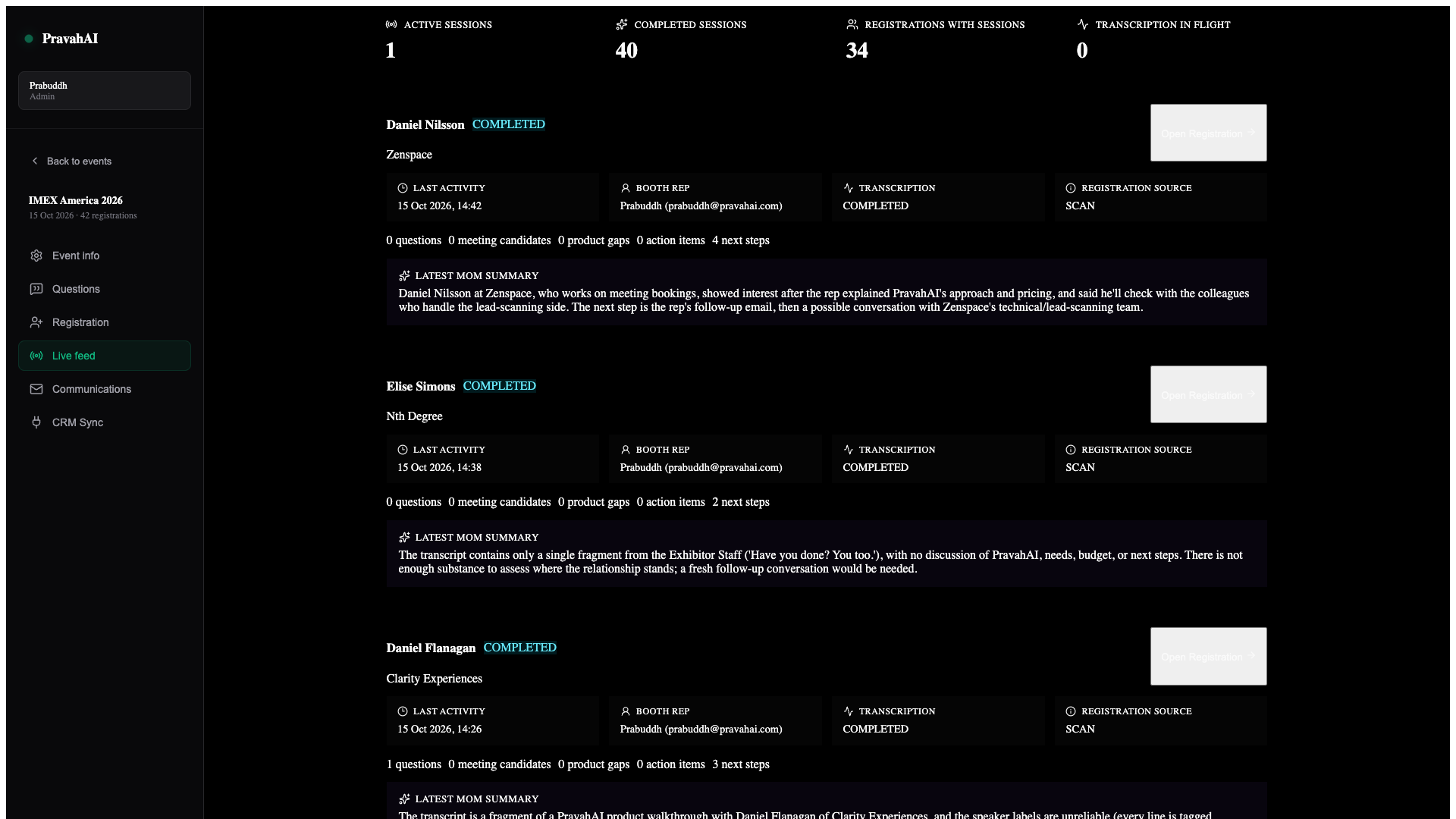
Pravah AI helps teams capture discovery milestones before leaving the booth. Account teams capture discovery milestones before leaving the booth, eliminating hotel room data entry entirely.
When qualification criteria map directly to your CRM fields, an account executive knows immediately whether a conversation represents an active opportunity or an unqualified browser.
A qualified floor conversation must capture four core data points within ninety seconds:
- Account Fit: Is the company within your Ideal Customer Profile (ICP)?
- Technical Pain: What specific infrastructure limitation or operational friction prompted the visit?
- Timeline: Are they evaluating solutions for current quarter deployment or exploratory research for next year?
- Next Action: Did the visitor agree to a private architecture review, a pricing audit, or a pilot demonstration?
Layer 3: Rapid CRM Pipeline Routing (Salesforce, HubSpot)
Ensure every qualified meeting syncs to your primary CRM before the sales rep begins their next conversation.
If an enterprise prospect confirms budget and deployment timelines, the system should instantly alert the dedicated account owner in Slack. While the prospect walks to their next keynote, their account executive receives a structured summary containing specific technical requirements, competitor mentions, and agreed next steps.
Follow-up occurs within four hours, not four business days.
How to audit your current event technology stack in 30 minutes
Before committing hundreds of thousands of dollars to your next exhibition footprint, run this four-question diagnostic with your field marketing and revenue operations leaders:
1. How many business days elapse between hall close and the first customized SDR follow-up email? If the answer exceeds 24 hours, your stack is costing you deal momentum. 2. Can your sales reps view complete technical notes from booth conversations in Salesforce without manual typing? If reps must transcribe paper notes from their hotel rooms, you lose half your commercial data. 3. Does your post event report display pipeline sourced and Cost Per Qualified Meeting (CPQM)? If your primary metric remains total badge scans, finance will eventually question your budget. 4. Do your project management boards talk to your revenue records? If your team manages Asana tasks in one silo while sales operates in another, you are managing logistics, not revenue.
For deeper analysis on connecting field conversations to downstream revenue, review our breakdown on why event leads take 3+ days to reach your CRM and our tactical framework for Salesforce routing beyond the CSV upload.
The bottom line on event tech investments
Three years spent perfecting Asana boards will guarantee that your team shows up on time with crisp signage and matching lanyards.
It will not help your reps close enterprise deals.
Trade show floors are the most expensive commercial space your business rents. When you pair disciplined project logistics with instant floor qualification, you stop collecting useless badge scans and start building auditable pipeline.